
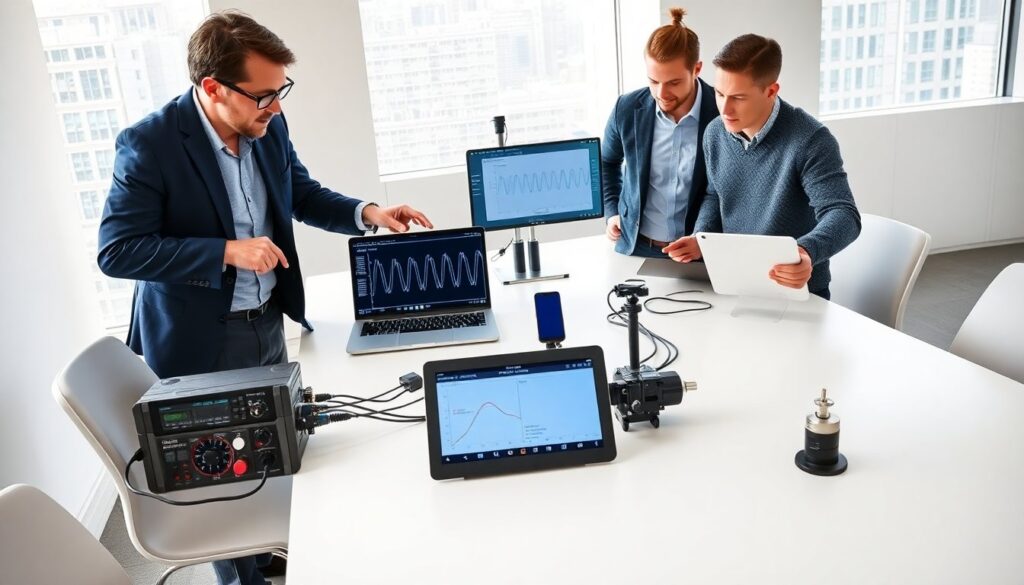
Virtual keystrokes haptics braptuner feedbackmagazine explain new ways to feel keys on screens and flat surfaces. The field blends hardware, software, and perceptual design. It gives users clear physical cues when they press virtual keys. This article defines the systems, shows how haptics simulate keystrokes, and reviews Braptuner’s role in precise tactile tuning.
Key Takeaways
- Virtual keystrokes combine touch input with haptic feedback to provide users with physical confirmation when pressing non-mechanical keys, enhancing typing speed and accuracy.
- Haptic technologies simulate keystroke feedback by converting electrical signals into precisely timed and controlled vibrations or motions, reducing latency to under 10 milliseconds for a natural feel.
- Braptuner is a specialized tool that enables precise tuning of tactile feedback by analyzing touch events and actuator responses, facilitating iterative testing and optimized user comfort.
- Using a mix of tactile actuators—such as motors, piezoelectric devices, and ultrasonics—allows designers to mimic the sensation of mechanical key presses with improved clarity and low power consumption.
- Haptic feedback integration spans multiple applications including mobile keyboards, in-car panels, and assistive devices, with design processes focused on user metrics like error rate, speed, and comfort.
- Future advancements aim to lower power usage, refine perceptual models for diverse users, and simplify integration to provide consistent, reliable virtual keystrokes haptics across products.
What Are Virtual Keystrokes And Why Haptics Matter
Virtual keystrokes describe button presses that occur on a non-mechanical surface. Designers map touch input to key events. Haptics deliver physical feedback that confirms those events. Users rely on that feedback to type faster and with fewer errors. Designers measure latency, force, and perceptible motion. They tune these metrics to match user expectations. The phrase virtual keystrokes haptics braptuner feedbackmagazine appears because the topic ties tactile tech, fine tuning, and coverage in specialist media. Users, researchers, and product teams care about repeatable, low-latency feedback that reduces cognitive load.
How Haptic Technologies Simulate Keystroke Feedback
Haptic systems create a sensed event that the brain treats like a key press. They convert electrical signals into motion or vibration. The systems control timing and intensity to match finger motion. Engineers test combinations to find the most convincing sensations. They reduce latency to under 10 milliseconds when possible. They also manage amplitude to avoid fatigue. The setup varies by interface. Mobile devices use different strategies than tabletop touch surfaces. Researchers report measurable gains in accuracy and speed when haptics provide consistent cues during typing tasks.
Tactile Actuators — Motors, Piezoelectric, And Ultrasonics
Small eccentric rotating mass motors produce broad vibration. They give a clear, low-cost pulse that users can feel. Linear resonant actuators deliver sharper, faster pulses with tighter control. Piezoelectric actuators move surfaces directly and create crisp taps. They operate with low power and low latency. Ultrasonic arrays modulate air pressure to create a sensation without direct contact. Engineers choose actuators by trade-offs in size, power, and clarity. They often combine actuator types to produce layered sensations that mimic mechanical key travel and click.
Braptuner And Its Approach To Precision Keystroke Tuning
Braptuner focuses on precise control of tactile timing and shape. The tool analyzes touch event traces and maps them to actuator commands. It provides parameter sets that designers can test rapidly. Braptuner also logs user response times and subjective ratings. Teams use those logs to select profiles that improve speed and comfort. The system supports iterative testing and automated sweeps across frequency, pulse length, and onset delay. That approach helps teams converge on a sensation that users call natural. Reviews in FeedbackMagazine note Braptuner’s focus on repeatable, measurable tuning.
Key Features And Unique Algorithms
Braptuner implements adaptive timing and perceptual shaping algorithms. The adaptive timing shortens pulse delay when users type quickly. The perceptual shaping changes pulse envelope to match finger dynamics. The software offers presets for common typing styles. It supports raw actuator control and higher-level abstractions. Braptuner can run A/B trials and export data for statistical analysis. The tool integrates with device firmware and with testing rigs. This integration helps teams move from lab findings to production code with minimal friction.
Design, Testing, And Practical Applications
Designers start with clear hypotheses about what users need. They select metrics like error rate, words per minute, and comfort. They test haptic profiles in controlled sessions and field trials. They gather both objective data and subjective feedback. They iterate quickly with tools such as Braptuner to refine sensations. Practical applications include mobile keyboards, in-car touch panels, and wearable controls. Each context requires different amplitude and latency targets. Accessibility teams also adopt haptics to help users with low vision or motor differences. They tune cues to make interfaces more reliable and predictable.
Use Cases, Accessibility, And Future Directions
Teams apply virtual keystrokes haptics braptuner feedbackmagazine lessons to many products. They improve typing on phones and foldables. They enhance control surfaces in appliances and medical devices. They create assistive profiles for users with limited touch sensitivity. Future work will push for lower power and finer control. Researchers will refine perceptual models that match diverse users. Engineers will also simplify integration so smaller teams can ship quality haptic feedback. The goal remains clear: give users reliable touch confirmation that reduces errors and increases confidence.